
Asbestos Inspection Guide

The CRE Buyer’s Guide to Asbestos Due Diligence

1. The Post-Purchase Surprise: Why Age is Irrelevant

“The building was constructed recently, so I don’t need to budget for asbestos.”

False. A common buyer’s mistake is assuming modern construction is asbestos-free. Federal and state
laws require a comprehensive inspection prior to any renovation or demolition, regardless of the
building’s age.

  • Current Manufacturing:
    Many asbestos-containing materials (ACMs) are still legally produced and used in construction today.
  • Recycled Materials:
    Newer builds often incorporate materials from older stock. Skipping an inspection during due
    diligence can lead to massive unbudgeted costs once the deal has closed.

2. Strategic Sampling: The “Presumption” Advantage

During the due diligence period, time is of the essence. Phoenix Environmental utilizes a strategic
approach to inspections that protects both your timeline and your capital:
  • The Power of “Assuming”:
    A licensed inspector has the legal authority to “presume” or “call” any suspect material asbestos
    without laboratory testing.
  • Why this Benefits the Buyer:
    Traditional sampling is physically destructive, often requiring the cutting of drywall or flooring,
    which a seller may not permit during a pre-closing walk-through. By assuming a material is ACM, you
    can account for high-confidence abatement costs without invasive sampling. This limits the number
    of samples required and speeds up your due diligence reporting.
  • The Burden of Proof:
    To declare a material “Non-ACM” and remove it from your liability column, the law requires rigorous
    AHERA-protocol sampling and certified lab analysis. You can never assume a material is safe; you
    can only prove it.
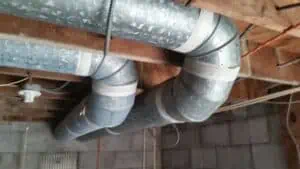
Asbestos-containing-duct-tape

Asbestos containing duct-tape

3. The 1% Regulatory Threshold

A material is legally classified as Asbestos-Containing Material (ACM) if it contains more than
1% asbestos. Unless a material is glass, solid metal, or rubber, it is considered a “suspect material”
until cleared by a certified Phoenix inspector.
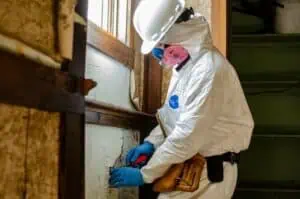
inspector

4. The Phoenix Acquisition Framework

Phoenix Environmental integrates into your due diligence team to provide a clear picture
of your potential liability:

  • I. Pre-Closing Inspection:
    We identify which materials require sampling and which should be assumed to protect your
    budget and your closing date.
  • II. Impact on Valuation & Capital Planning:
    Identifying ACM, whether confirmed by lab results or strategically assumed, is critical for
    accurately forecasting your Capital Expenditure (CapEx). This data allows you to quantify
    the cost of future abatement, which is essential for negotiating credits, adjusting your
    purchase price, or refining your internal financial modeling.
  • III. Regulatory & Notification Management:
    If your post-acquisition plan involves disturbing 260+ linear feet of pipe or 160+ square
    feet of other materials, a 10-day notification to the EPA/DNR is mandatory. Phoenix ensures
    your project hits the ground running on Day 1 of ownership.

5. “Friable” vs. “Non-Friable” (Understanding the Line Item)

As a buyer, you must distinguish between these two categories to understand your future
O&M (Operations & Maintenance) costs:
  • Friable (High Risk / High Cost):
    Materials that crumble under hand pressure (e.g., pipe wrap, popcorn ceilings). These
    require intensive containment and can complicate tenant build-outs.
  • Non-Friable (Lower Risk):
    Materials like floor tiles or siding. These are manageable as long as they remain intact,
    but become a major expense if your renovation plans involve sanding, grinding, or mechanical demolition.

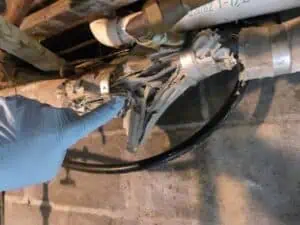
Asbestos-containing Air-o-Cell pipe insulation

6. High-Probability “Red Flags” for Buyers

  • Mechanical Systems:
    Boilers, heaters, and “Air-o-Cell” pipe insulation.
  • Architectural Finishes:
    Plaster, drywall mud, and acoustical sprays.
  • Flooring Systems:
    9″x9″ tiles and the associated black “mastic” adhesives.


To help us dive deeper into how this impacts your specific deal, which of these strategic
entry points would you like to explore first?

  • Strategic Presumption:
    We can discuss how choosing to assume asbestos presence can actually be a negotiating tool
    during your due diligence window.
  • The 1% Rule and Testing:
    We can look at the technical process of AHERA sampling and why proving a material is safe
    is much harder than assuming it is dangerous.
  • Budgeting for Friability:
    We can explore why the physical state of the material (friable vs. non-friable) creates
    such a massive difference in your post-closing renovation budget.
Asbestos-location